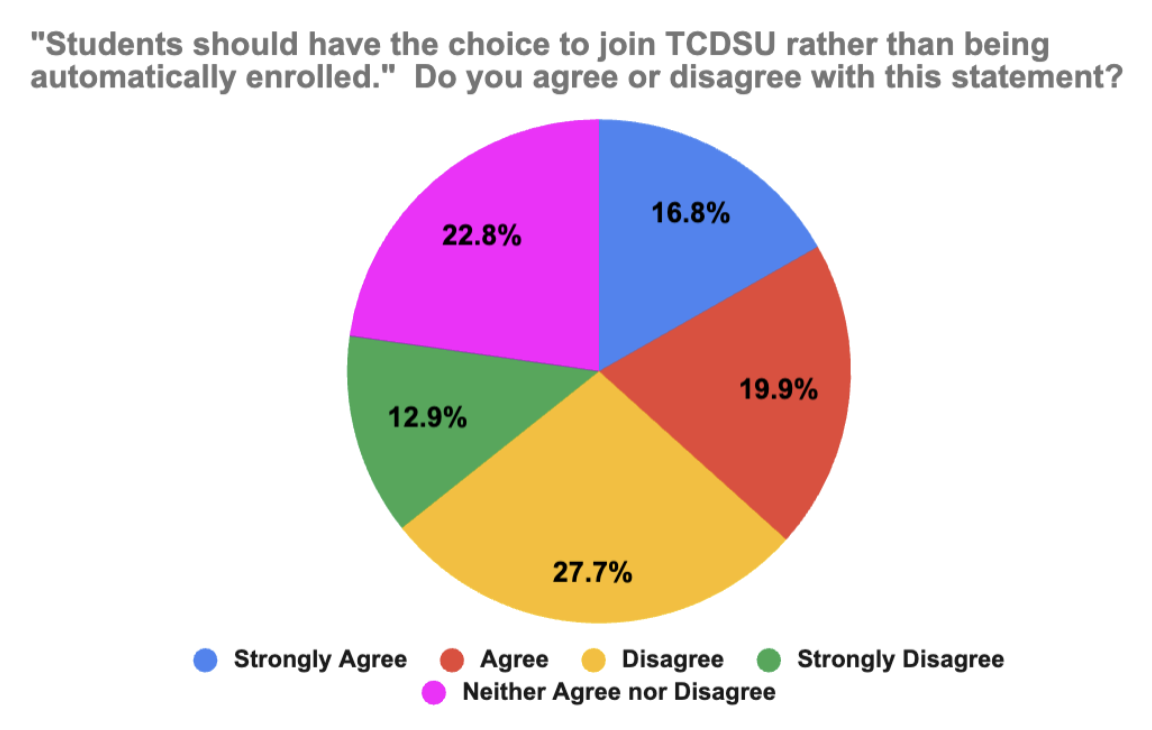
The first time the question was polled in the annual Trinity News TCDSU sabbatical elections opinion poll, students were asked their stance on whether membership of TCDSU should be mandatory or would they prefer if students had a choice to join or not. The poll was conducted between 18 and 21 February, and this specific question received responses from 835 students, indicating a margin of error of plus or minus 3.4%
Currently, all students are automatically enrolled in the union, with TCDSU receiving nearly €400,000 in funding from the capitation grant in the 2022/23 academic year, according to the Financial Statements provided by the union. This money is a portion of the Student Levies & Charges fee, which among other expenses, is shared between the four capitated bodies on campus - The Central Societies Committee, Trinity Sport Union, TCDSU, and Trinity publications. In response to being asked if students should have the choice to join TCDSU, 16.8% strongly agreed with the statement, while 19.9% indicated that they agreed. 27.7% of students disagreed with the sentiment that membership should be optional, with 12.9% strongly disagreeing. 22.8% of students neither agreed or disagreed with the statement.
The demographics that most supported a choice to join TCDSU were students in Multi faculty courses, Senior Freshman, and male students with 48.8%, 44.7%, and 43.9% in some sort of agreement with the proposition respectively. In contrast, only 21.4% of non binary students, 27.9% of Senior Sophister students, and 32% of Female students are either in full or partial agreement with the question.
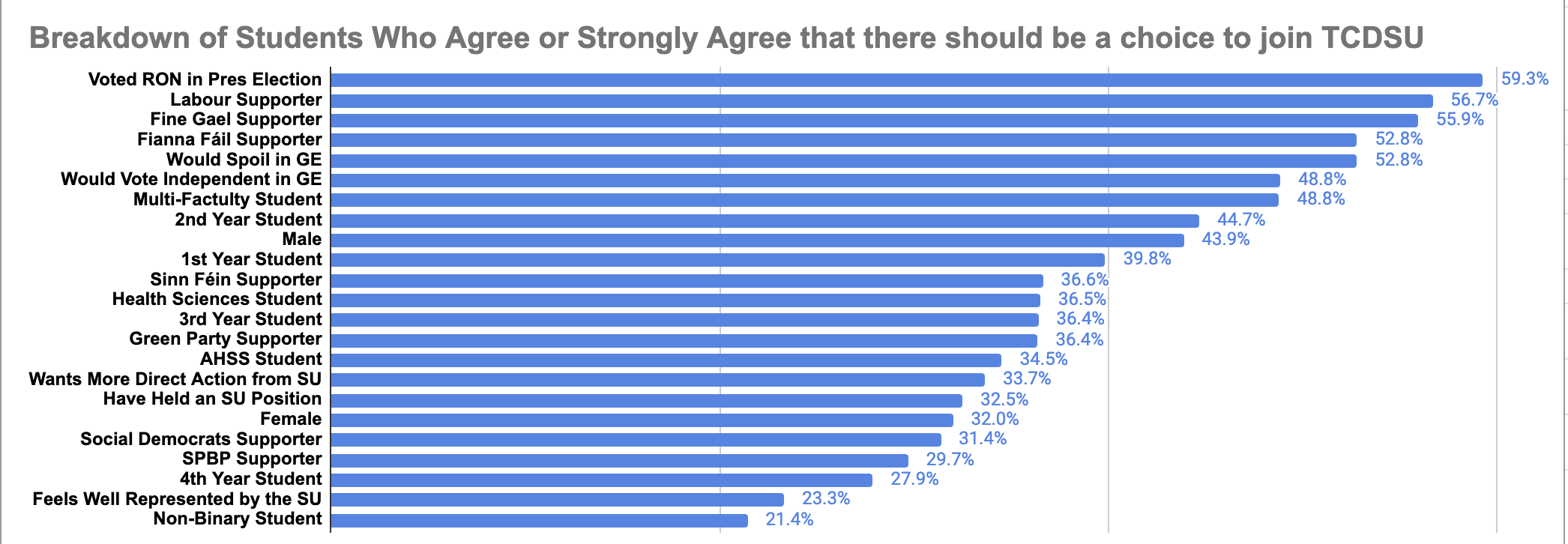
To introduce an optional membership structure, Section 1.2 of the TCDSU constitution must be amended. A change to this part of the constitution would require either two-thirds of a TCDSU council meeting to vote in favour of a referendum, or a petition signed by 500 students. The referendum would then need to garner support from over 50% of students to be passed. While a combined 37% of respondents indicated a preference for an opt-in system would not be enough to enact such a measure, two findings in the data could make the unions mandate less stable. First, nearly a quarter of respondents were undecided on the hypothetical proposal; in a real referendum, a shift in the sentiment of these voters could swing the outcome. Second, there is widespread dissatisfaction: 42.5% feel unsupported by College and 41.2% feel unrepresented by TCDSU. 80% of those who feel unrepresented by the union would back an optional membership system.